

Chess is one of the most respected strategy games in the world, and the board is where everything begins. Before a player can master openings, tactics, or endgames, they need to understand the chess board itself. A proper understanding of the board helps with movement, planning, defense, and attack. Whether you are using a wooden Chess Set, learning through a digital app, or practicing on an Online chess board, the board remains the heart of every Chess game.
Many beginners jump straight into moving the pieces without first learning how the board works. That often creates confusion later. The board is not just a pattern of black and white squares. It is a structured battlefield with names, rules, directions, and strategic meaning. Once you understand the board, the logic of the Chess board game becomes much easier to follow.


This article explains the board in a clear, professional, and beginner-friendly way while covering setup, piece placement, rules, and smart playing principles.
Chess board setup and rules
A chess board is built with 64 alternating light and dark squares arranged in an 8×8 grid. Each player starts with 16 pieces, making 32 pieces in total. The goal of the game is to checkmate the opponent’s king, but before the first move happens, the board must be set correctly.
The rules of setup matter because every piece has a fixed starting position. If the board is turned the wrong way or the queen and king are placed on the wrong squares, the game will not begin in a legal position. That is why Chess board setup is one of the first things every player should learn.
Understanding the rules of the board also makes it easier to study moves, openings, and strategy later on.
How many squares on a chess board
A standard chess board has 64 squares. These squares are arranged in:
- 8 horizontal rows called ranks
- 8 vertical columns called files
This creates an 8 by 8 board. There are 32 light squares and 32 dark squares. Every official Chess board game uses this same structure, whether it is played on a physical board or an Online chess board.
Knowing how many squares are on the board may seem basic, but it helps you understand how the pieces move, how control works, and why the center is so important in a real Chess game.
Chess board layout with names
The board is divided into named coordinates so that each square can be identified clearly. This system is often referred to as Chess board names.
The files are labeled from a to h, and the ranks are numbered from 1 to 8. When you combine a file and a rank, you get the name of a square. For example:
- a1
- c4
- e5
- h8
This is why players can describe moves precisely. Instead of saying “move that bishop to the middle,” they say “Bishop to c4.”
Learning the Chess board layout with names is essential if you want to follow lessons, study books, read chess notation, or improve through online play. It is a basic skill, but it gives you a much stronger foundation.
Chess board Pieces
A complete chessboard starts with 32 pieces, 16 for each side. These pieces are:
- 1 King
- 1 Queen
- 2 Rooks
- 2 Bishops
- 2 Knights
- 8 Pawns
Each of these Chess board Pieces has its own role and movement pattern. The king is the most important piece because the entire game is about protecting your king and attacking the opponent’s. The queen is the most powerful in movement. Rooks dominate open files, bishops control diagonals, knights jump in unusual patterns, and pawns shape the structure of the position.
Understanding the pieces is important, but understanding where they belong on the board is equally important.
How to set up a chessboard correctly?
To set up a chessboard correctly, begin by placing the board so that the bottom-right corner is a light square. This is the first rule of proper Chess board setup.
After that, place the pieces in their standard positions:
- Rooks go in the corners
- Knights go next to the rooks
- Bishops go next to the knights
- Queen goes on her own color
- King goes on the remaining central square
- Pawns fill the row in front of the main pieces
For White, the back row from left to right is:
Rook, Knight, Bishop, Queen, King, Bishop, Knight, Rook
Black mirrors the same setup on the opposite side.
A correct starting position is necessary for a fair and legal Chess game.
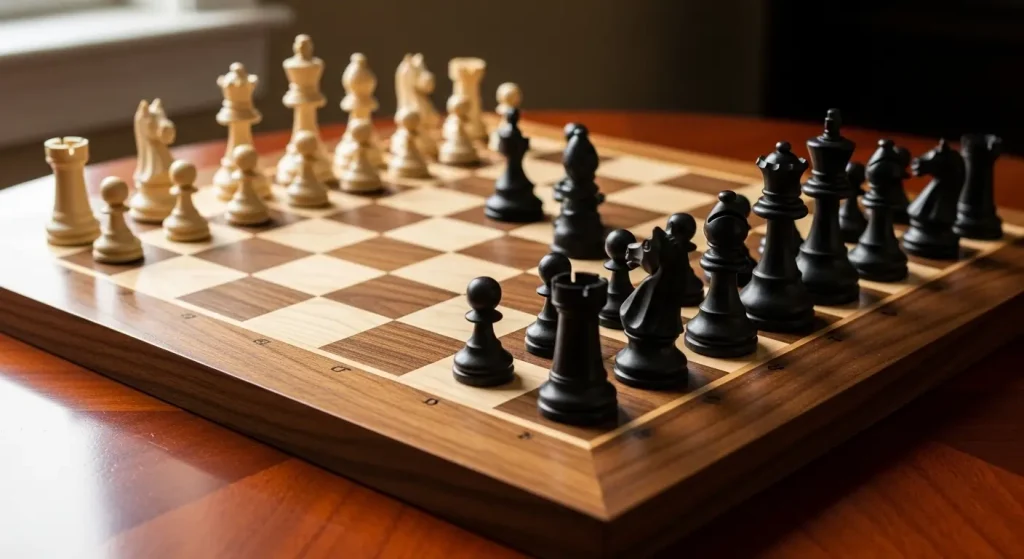
How to set up a chess board for beginners
For beginners, the easiest way to learn setup is to follow a step-by-step approach.
First, put the board in the correct direction. Remember this simple rule: light square on the right.
Second, place the rooks in the four corners.
Third, put the knights next to the rooks.
Fourth, place the bishops next to the knights.
Fifth, place the queen on her matching color square.
Sixth, place the king on the remaining central square.
Finally, place all eight pawns in the row directly in front of the major pieces.
If you are just starting out, practicing How to set up a chess board for beginners a few times helps build confidence. After a while, the arrangement becomes automatic.
Is king on the right or the left?
This is one of the most common beginner questions.
The answer is: the king is not always simply on the right or the left by itself. It depends on which color you are playing and how you are looking at the board. What really matters is the queen and king relationship.
For White, the queen starts on d1 and the king starts on e1.
For Black, the queen starts on d8 and the king starts on e8.
So if you look at the White side in the proper setup, the king stands to the right of the queen. The same pattern applies to Black from that side as well.
The easiest way to remember it is not by left or right alone, but by remembering that the queen goes on her own color and the king takes the remaining square.
Does queen go on her color?
Yes, the queen always goes on her own color.
This is one of the most important setup rules in chess:
- White queen goes on the light square d1
- Black queen goes on the dark square d8
That means the white queen starts on a white square, and the black queen starts on a black square. Once the queen is placed correctly, the king goes on the square next to her.
If you remember this rule, it becomes much easier to avoid setup mistakes.
Chess board setup diagram
A simple way to picture the back-row arrangement is this:
White back row from left to right:
Rook, Knight, Bishop, Queen, King, Bishop, Knight, Rook
White pawns:
All eight pawns go on the second rank
Black back row from left to right:
Rook, Knight, Bishop, Queen, King, Bishop, Knight, Rook
Black pawns:
All eight pawns go on the seventh rank
If you imagine the board with square names, the major starting positions are:
White:
Rooks on a1 and h1
Knights on b1 and g1
Bishops on c1 and f1
Queen on d1
King on e1
Pawns on a2 to h2
Black:
Rooks on a8 and h8
Knights on b8 and g8
Bishops on c8 and f8
Queen on d8
King on e8
Pawns on a7 to h7
This text version works like a beginner-friendly Chess board setup diagram and helps players memorize the starting position more easily.
What are the basic rules of chess?
The basic rules of chess are simple to learn, even though the game itself can become very deep.
Each player takes turns moving one piece at a time. White moves first. Every piece has its own legal movement pattern. The aim is to attack the opponent’s king in a way that cannot be escaped. That is called checkmate.
A player must also follow these basic ideas:
- You cannot move through pieces unless the piece is a knight
- You cannot leave your own king in check
- Pawns move forward but capture diagonally
- The king moves one square at a time
- Special rules include castling, en passant, and pawn promotion
These are the core rules behind every Chess game, whether played casually, competitively, or on an Online chess board.
Chess board rules
The board itself influences the rules of the game in powerful ways. The color of squares matters, the lines matter, and the coordinates matter.
Important Chess board rules include:
A bishop always stays on the same color squares throughout the game.
A rook moves along ranks and files.
A queen moves across files, ranks, and diagonals.
A knight jumps in an L-shape.
The king may never move into check.
Pawns move toward the other side of the board and promote upon reaching the final rank.
The board also shapes strategy. Central squares such as e4, d4, e5, and d5 are more valuable because pieces placed there control more space. This is why experienced players fight for the center from the very beginning.
How to play chess board
To learn How to play chess board positions well, you must think about more than moving pieces. Good chess means understanding space, timing, piece activity, king safety, and structure.
A beginner should focus on these early ideas:
Develop pieces quickly.
Control the center.
Castle early to keep the king safe.
Avoid moving the same piece too many times in the opening.
Do not bring the queen out too early.
Look at what your opponent is threatening before every move.
When you learn how the board works, you stop seeing random squares and begin seeing patterns. That is when real improvement begins.
Set up chess position online
Today, many players learn faster by using digital tools. You can Set up chess position online through training websites, analysis boards, and learning apps. This is useful because it allows you to recreate a position, test moves, solve puzzles, or study openings without needing a physical set in front of you.
An Online chess board is also excellent for reviewing mistakes. You can load a position, move pieces around, and understand what should have happened. For teachers, students, and self-learners, this is one of the easiest ways to study chess deeply.
Many players also enjoy Online chess 2 player modes because they can practice against friends or strangers from anywhere in the world. This makes modern chess more accessible than ever.
Strategy inside the chess board
Once you know the rules and setup, the next step is strategy. The board is not just where the pieces stand. It is where plans are built.
The center of the board is especially important because pieces control more squares from central positions. A knight in the center is usually much stronger than a knight on the edge. Bishops become dangerous when diagonals are open. Rooks grow stronger on open files. The queen becomes powerful when she combines with other pieces instead of moving alone.
Strong players also look for weak squares, open lines, and better piece placement. They understand that the board tells a story. Every square can become a strength or a weakness depending on how the position develops.
Physical board vs Online chess board
A traditional board gives players a classic and focused experience. Many people enjoy the feel of a wooden Chess Set, the weight of the pieces, and the habit of playing face to face. Physical boards are ideal for home study, club play, and tournament practice.
At the same time, an Online chess board offers speed, flexibility, and learning tools. You can practice openings, solve puzzles, play fast games, or analyze mistakes instantly. For many modern players, both formats are useful. One builds tactile familiarity, and the other offers unlimited practice.
Choosing a Chess Set
The right Chess Set can make learning and playing much more enjoyable. Beginners usually do best with a clear and simple design. Pieces should be easy to recognize, and the squares should be large enough to avoid clutter.
When choosing a set, think about:
- board size
- material
- durability
- piece weight
- visibility
- portability
A decorative set may look beautiful, but a practical set is often better for regular study and play.
Chess Board price
Chess Board price can vary widely depending on style, quality, and material. A basic beginner board is usually affordable, while handcrafted wooden boards or luxury collector sets can be much more expensive.
In general:
- beginner boards are budget-friendly
- tournament boards are practical and durable
- wooden sets are more premium
- decorative or luxury sets cost the most
When comparing Chess Board price, it is smart to think about purpose first. If you are learning the game, you do not need the most expensive board. A simple, readable, and well-made board is often the best choice.
Why understanding the board matters in every Chess game
Every strong Chess game starts with proper board awareness. The setup determines legality. The layout shapes movement. The square names make study possible. The rules define what each piece can do. The strategy grows out of board control.
Without understanding the board, a player is just moving pieces. With understanding, a player begins to think like a real chess player.
That is why beginners should not rush past the basics. Learning the board well creates a foundation for better openings, cleaner tactics, smarter plans, and more confidence in play.
Final thoughts
The chess board is more than a surface. It is the structure behind every idea in chess. From Chess board setup to square names, from the proper role of the king and queen to understanding movement and control, the board shapes everything that happens in a match.
If you want to improve, begin with the board. Learn the setup. Learn the names. Learn the rules. Study positions on a physical board and on an Online chess board. Practice through Online chess 2 player games. Choose a comfortable Chess Set that suits your needs and budget. Even things like Chess Board price become easier to judge when you know what matters most.
In the end, the pieces may move, but the board gives the game its meaning.